
TL;DR
Unarmed security guards help protect people and property by monitoring facilities, controlling access, conducting patrols, documenting incidents, and responding appropriately to emergencies.
Their specific responsibilities depend on the employer and assigned location.
Common unarmed security guard duties include:
Monitoring entrances and checking credentials
Patrolling buildings, parking areas, and property
Watching surveillance cameras and responding to alarms
Identifying safety and security concerns
Documenting incidents and daily activities
Assisting visitors, employees, residents, and customers
Contacting supervisors, police, firefighters, or medical responders when needed
Before working as an unarmed security guard in Arizona, applicants must complete the applicable training and licensing requirements established by the Arizona Department of Public Safety.
Private security protects office buildings, residential communities, stores, warehouses, hospitals, construction sites, and many other properties throughout Arizona.
While the surroundings may change, the basic responsibility remains the same: observe what is happening, identify potential concerns, follow site procedures, and respond professionally.
An unarmed security guard does not carry a firearm as part of the assignment. The work generally emphasizes prevention, observation, communication, access control, and incident reporting rather than physical intervention.
Understanding what the job involves can help you decide whether private security fits your abilities and career goals. It also helps you recognize why Arizona requires training before issuing a security guard registration certificate.
What Is an Unarmed Security Guard?
An unarmed security guard is employed to help protect people, buildings, property, equipment, or information without carrying a firearm while performing the assigned duties.
Some Arizona employers use the title “security officer,” while others use “security guard.”
The job title may vary, but the work typically involves maintaining a visible presence, monitoring activity, enforcing property rules, identifying potential risks, and reporting incidents.
Security guards are not police officers. They do not have the same authority, responsibilities, or legal protections as sworn law enforcement personnel. Guards must understand the limits of their role and follow Arizona law, employer policies, training requirements, and the written instructions for the assigned location.
Those location-specific instructions are often called post orders. Post orders explain the guard’s responsibilities, patrol schedule, emergency procedures, reporting expectations, important contacts, and other requirements for a particular assignment.
Common Unarmed Security Guard Duties
The exact duties of an Arizona security guard depend on the property, employer, shift, and client. A guard working at a gated community may spend much of the shift managing visitors.
A warehouse guard may focus on vehicles, loading areas, and inventory access. A hospital security officer may interact with patients, employees, and visitors in emotionally charged situations.
The following responsibilities are common across many unarmed security assignments.
Control Access to the Property
Controlling access means helping ensure that only authorized people enter restricted areas. Depending on the site, the guard may:
Check employee identification
Review visitor credentials
Maintain visitor logs
Issue temporary passes
Contact employees to confirm appointments
Inspect delivery documentation
Monitor gates, doors, or turnstiles
Enforce entry and exit procedures
Prevent access to restricted areas
Access control requires attention to detail and consistent application of the property’s rules.
Allowing an unauthorized person to enter because the location is busy or the visitor appears familiar can create a serious security problem.
Professional communication is also important. Guards must explain access requirements clearly without becoming argumentative or treating authorized visitors disrespectfully.
Patrol Buildings and Grounds
A visible patrol can discourage theft, vandalism, trespassing, and other unwanted activity. Patrols also help guards identify safety problems before someone is injured or property is damaged.
During a patrol, a security guard may check for:
Unlocked or damaged doors
Open windows
Broken gates or fencing
Poor lighting
Water leaks
Fire hazards
Blocked exits
Suspicious vehicles
Unauthorized people
Damaged cameras or alarm equipment
Unusual sounds, odors, or activity
Patrols may be completed on foot, by vehicle, or with an electronic checkpoint system.
Guards must remain observant and document what they find rather than treating the patrol as a routine walk through the property.
Monitor Cameras and Alarm Systems
Many security officers work at a front desk, gatehouse, reception area, or security operations center equipped with surveillance and alarm systems.
Monitoring responsibilities may include:
Watching live security-camera feeds
Reviewing activity at entrances and loading areas
Responding to access-control alerts
Acknowledging fire or intrusion alarms
Contacting personnel assigned to investigate
Recording the time and location of an incident
Preserving video or other information according to site procedures
Technology can help a guard monitor a large property, but equipment does not replace good judgment.
The guard must recognize when an activity requires closer attention and follow the correct response procedure.
Identify Safety and Security Concerns
Security guards frequently notice problems that are not crimes but could still endanger people or damage property.
Examples include a wet floor, an obstructed fire exit, a malfunctioning door, exposed wiring, an unattended package, or a vehicle blocking emergency access.
Depending on the situation, the guard may secure the area, notify the appropriate department, warn people about the hazard, or request emergency assistance.
A good security guard does not ignore a concern simply because it falls outside a narrow definition of theft or trespassing. Protecting a property also involves recognizing conditions that could lead to injury, disruption, or loss.
Respond to Incidents and Emergencies
Security guards are often among the first people to observe or receive notice of an incident. Their response can affect how quickly the appropriate help arrives.
Depending on the assignment and level of training, a guard may:
Call 911 or another emergency number
Notify a supervisor or property manager
Direct first responders to the correct location
Help communicate evacuation instructions
Restrict access to an affected area
Preserve an incident scene
Observe and document relevant details
Provide information to police, firefighters, or medical personnel
Follow the emergency procedures contained in the post orders
Responding appropriately does not always mean intervening physically.
In many situations, the safest and most effective response is to observe, communicate, request assistance, and keep other people away from danger.
Prepare Daily Logs and Incident Reports
Writing is a major part of private security work. Daily activity logs show what occurred during a shift, while incident reports document specific events that may require review by supervisors, clients, insurance companies, attorneys, or law enforcement.
A useful security report should be:
Accurate
Factual
Clear
Chronological
Specific
Legible
Free from unsupported conclusions
The report should describe what the guard personally observed, what other people said, which actions were taken, and when each event occurred. Opinions, exaggerations, and assumptions can reduce the value of the report.
Accurate documentation also allows the next shift to understand unresolved issues, unusual activity, equipment problems, or changes at the property.
Assist Employees, Residents, Customers, and Visitors
Many unarmed security jobs include a substantial customer-service component. A guard may provide directions, answer basic questions, help someone locate an office, manage a line, escort a visitor, or explain property procedures.
A professional and approachable presence can help people feel safer while making security rules easier to enforce. Guards must often balance courtesy with the need to remain alert and apply policies consistently.
Where Do Unarmed Security Guards Work?
Unarmed security guards can work in many environments, including:
Corporate offices
Apartment and condominium communities
Gated neighborhoods
Retail stores and shopping centers
Warehouses and distribution centers
Hospitals and medical offices
Hotels and resorts
Schools and college campuses
Construction sites
Manufacturing facilities
Data centers
Parking facilities
Entertainment venues
Special events
Each environment creates different responsibilities. Retail security may concentrate on theft prevention and customer interactions.
Construction-site security may focus on controlling after-hours access and protecting equipment. Residential guards may spend more time managing gates, guests, vendors, and neighborhood patrols.
Applicants should read job descriptions carefully and ask prospective employers about schedules, physical requirements, work environments, uniforms, equipment, and expected responsibilities.
What Skills Do Unarmed Security Guards Need?
Employers can teach site procedures, but successful guards generally bring several important personal and professional qualities to the job.
Situational Awareness
Situational awareness means paying attention to your surroundings and recognizing when something does not fit the normal pattern.
A door that is usually locked may be open. A vehicle may remain in a restricted area longer than expected. A person may be attempting to avoid an access checkpoint.
Observing these details can help prevent incidents or produce useful information when something occurs.
Clear Communication
Security guards communicate with coworkers, supervisors, clients, visitors, emergency dispatchers, and law enforcement officers.
They must provide information clearly, listen carefully, and remain professional when another person is frustrated or upset.
De-Escalation
Not every disagreement needs to become a confrontation. Calm language, respectful instructions, active listening, and appropriate distance can help reduce tension.
Guards should follow their training and site procedures while avoiding language or behavior that unnecessarily intensifies a situation.
Report Writing
Security reports must communicate what occurred to someone who was not present. Guards need to record names, locations, times, observations, statements, and actions accurately.
Reliability
Security assignments depend on guards arriving on time, remaining at their posts, completing required patrols, and following procedures.
An unattended post or incomplete patrol can leave a property vulnerable.
Professional Judgment
Unexpected situations are common in security work. Guards need to evaluate what is happening, determine which procedures apply, and recognize when a supervisor or emergency service should be contacted.
Basic Technology Skills
Modern security work may involve digital visitor systems, mobile reporting applications, surveillance equipment, access-control software, radios, and electronic patrol checkpoints.
Comfort with basic technology can make training and daily work easier.
What Should an Unarmed Security Guard Avoid Doing?
Security guards must operate within the limits of their training, authority, post orders, and Arizona law. They should not take unnecessary risks or behave as if they possess the same authority as police officers.
An unarmed guard should avoid:
Claiming to be a police officer
Ignoring established site procedures
Using unnecessary force
Escalating verbal disagreements
Leaving an assigned post without authorization
Sharing confidential information
Falsifying patrol logs or incident reports
Making assumptions in official documentation
Handling situations beyond the guard’s training
Promising an outcome that the guard cannot control
When uncertain, the appropriate response may be to maintain observation, create distance, notify a supervisor, and contact law enforcement or emergency services.
What Does a Typical Security Guard Shift Look Like?
No two assignments are identical, but a typical shift may follow this general sequence:
Arrive on time and receive a briefing from the previous guard.
Review the post orders, current instructions, and recent incident reports.
Confirm that assigned radios, keys, cameras, and other equipment are functioning.
Monitor entrances, cameras, alarms, or visitor activity.
Conduct scheduled patrols and document each patrol.
Respond to calls, observed concerns, or reported incidents.
Prepare reports and update the daily activity log.
Brief the incoming guard about unresolved concerns or unusual activity.
Some shifts are quiet and routine. Others involve frequent contact with employees, visitors, deliveries, alarms, or emergencies. Guards must remain attentive even when little appears to be happening.
Can Security Work Lead to Other Career Opportunities?
Unarmed security experience can help guards develop communication, observation, documentation, and emergency-response skills.
With a strong work record and additional qualifications, a guard may pursue positions such as:
Shift supervisor
Site supervisor
Field supervisor
Account manager
Loss-prevention specialist
Corporate security officer
Hospital security officer
Security operations center operator
Training instructor
Armed security guard
Advancement is not automatic. Opportunities depend on experience, employer requirements, job performance, additional training, and any licenses or registrations required for the position.
How Do You Prepare to Work as an Unarmed Security Guard in Arizona?
Arizona regulates private security guards through the Arizona Department of Public Safety. Applicants must meet the applicable eligibility, training, application, fingerprinting, and background-screening requirements.
Arizona’s unarmed guard training includes eight hours of required instruction.
The curriculum addresses subjects such as legal authority, communication, report writing, use of force, crime-scene preservation, ethics, emergency response, and general security procedures.
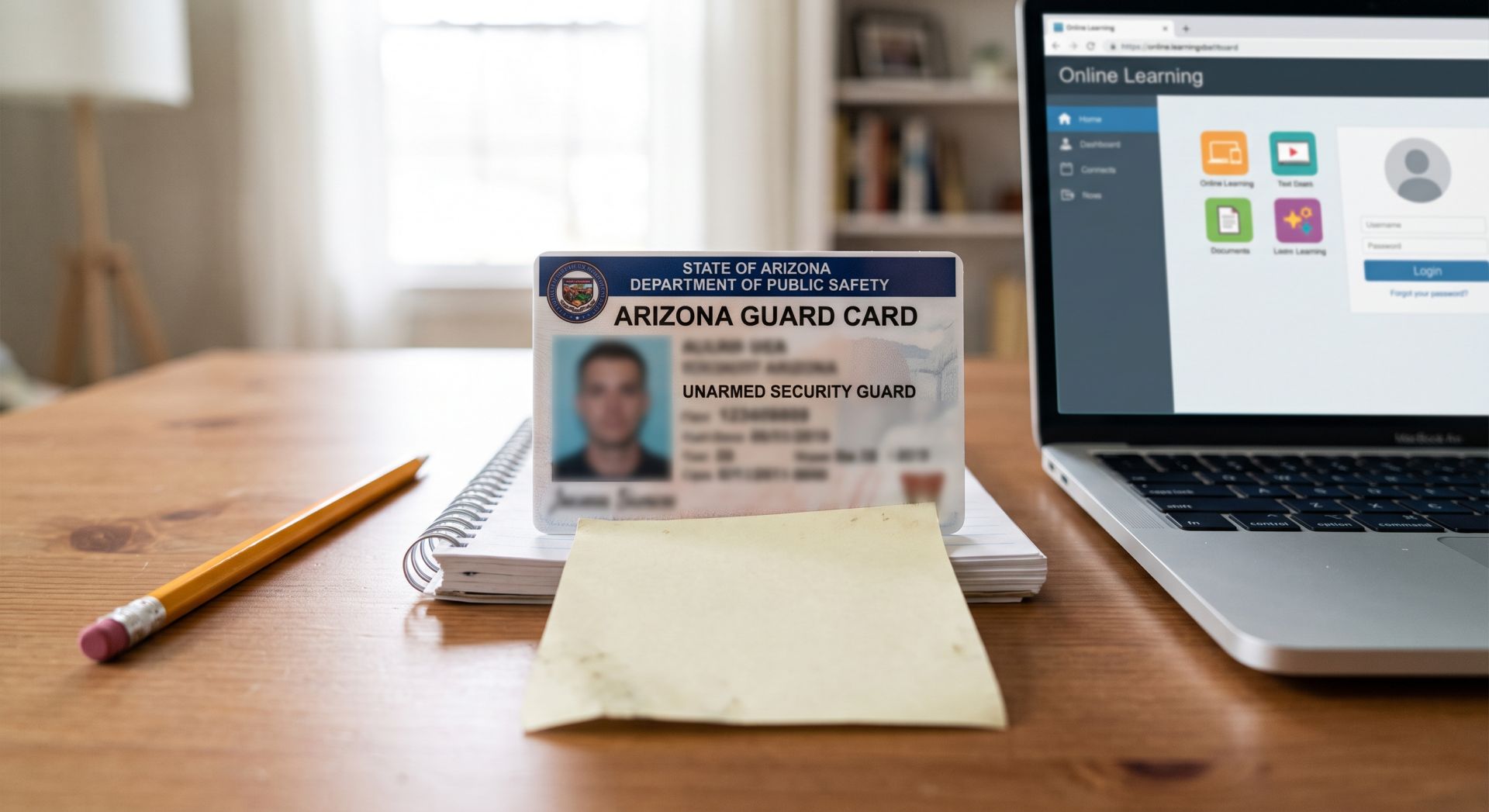
GuardCard.com provides Arizona unarmed security guard training online, allowing you to complete the required coursework without traveling to a scheduled classroom.
You can access the course from a computer, tablet, or phone and complete it around your existing schedule.
Training is only one part of the process. Arizona DPS reviews applications and issues the security guard registration certificate. Completing a course does not mean your application has been approved or that DPS has issued your guard card.
GuardCard.com’s Bundle Package combines the required online training with guidance for navigating the Arizona DPS application process.
The package helps applicants understand the portal, prepare the necessary information, follow fingerprinting instructions, and complete the steps that follow training.
Review the current requirements through the Arizona DPS Licensing Unit before submitting your application.
Prepare for Your Arizona Security Career
Unarmed security guards perform work that requires observation, communication, sound judgment, and consistent attention to detail.
Understanding these responsibilities can help you decide whether the job fits your interests and abilities.
When you are ready to take the next step, GuardCard.com lets you complete your required Arizona unarmed guard card training online and on your schedule.
Choose the standard training course or select the Bundle Package for additional guidance through the Arizona DPS application process.
Visit GuardCard.com to begin your Arizona unarmed security guard training.
Frequently Asked Questions About Unarmed Security Guard Duties
What does an unarmed security guard do?
An unarmed security guard monitors property, controls access, conducts patrols, identifies potential safety or security concerns, documents incidents, and responds according to employer procedures. Specific responsibilities vary by location and assignment.
Do unarmed security guards carry weapons?
An unarmed security guard does not carry a firearm as part of the assignment. Employer policies and Arizona requirements determine whether other authorized equipment may be carried and what additional training is required.
Are security guards police officers?
No. Private security guards are not sworn police officers and do not have the same legal authority. They must work within Arizona law, their training, employer policies, and the post orders for their assigned location.
Do unarmed security guards respond to emergencies?
Yes. Depending on the situation and assignment, a guard may call emergency services, notify supervisors, guide first responders, assist with evacuations, restrict access, preserve an incident scene, and document what occurred.
Do security guards need strong writing skills?
Security guards regularly prepare daily logs and incident reports. Clear, accurate, and factual writing is important because employers, clients, insurers, attorneys, or law enforcement personnel may review these records.
Do I need previous security experience?
Many unarmed security positions do not require previous security or law-enforcement experience. Requirements vary by employer. Applicants must still meet Arizona’s applicable training and licensing requirements.
Do I need an Arizona guard card before working?
Arizona requires security guards to hold the applicable registration before performing regulated security work, subject to any limited exceptions provided by law. Completing training or submitting an application does not by itself authorize you to begin working.
Can I complete Arizona unarmed guard training online?
Yes. GuardCard.com provides the required Arizona unarmed security guard training online. Students can access the course without traveling to a scheduled classroom and can select the Bundle Package for additional application guidance.