
TL;DR
Unarmed guard card training in Arizona requires completing an eight-hour state-mandated course, passing a background check, and submitting a formal application through the Arizona Department of Public Safety.
Complete eight hours of certified pre-assignment security training.
Submit your DPS security guard license application and pay the $72 DPS fee.
Submit fingerprints for a mandatory FBI criminal background check.
Wait for AZDPS to issue your official security guard registration.
Starting a career as an unarmed security guard in Arizona begins with a clear understanding of the regulatory landscape. The Arizona Department of Public Safety (AZDPS) serves as the primary governing body overseeing the licensing of all individuals tasked with protecting property and people.
If you’re looking to get into the workforce quickly, the most common entry point is obtaining an unarmed guard card. This credential acts as official state registration. It proves to employers that you passed a rigorous background check and met all educational requirements.
Arizona offers a wide range of security guard opportunities, from corporate security at office complexes to residential communities and public venues. To begin working, you must complete specific training and administrative steps to ensure both public safety and professional readiness.
The 8-Hour Unarmed Security Guard Card Educational Benchmark
Arizona is precise about what it expects from its security personnel. To qualify for an unarmed guard card, you must complete eight (8) hours of pre-assignment instruction.
This statutory requirement under Arizona Revised Statutes Title 32, Chapter 26, provides a baseline of knowledge so that an officer’s first day on the job is marked by competence and confidence.
Many local academies and online platforms provide unarmed guard card training that adheres to the AZDPS-mandated syllabus. During these eight hours, you will learn the legal limitations of the role. Unlike police officers, private security staff operate with the authority of a private citizen, and understanding this distinction is critical to staying compliant on the job.
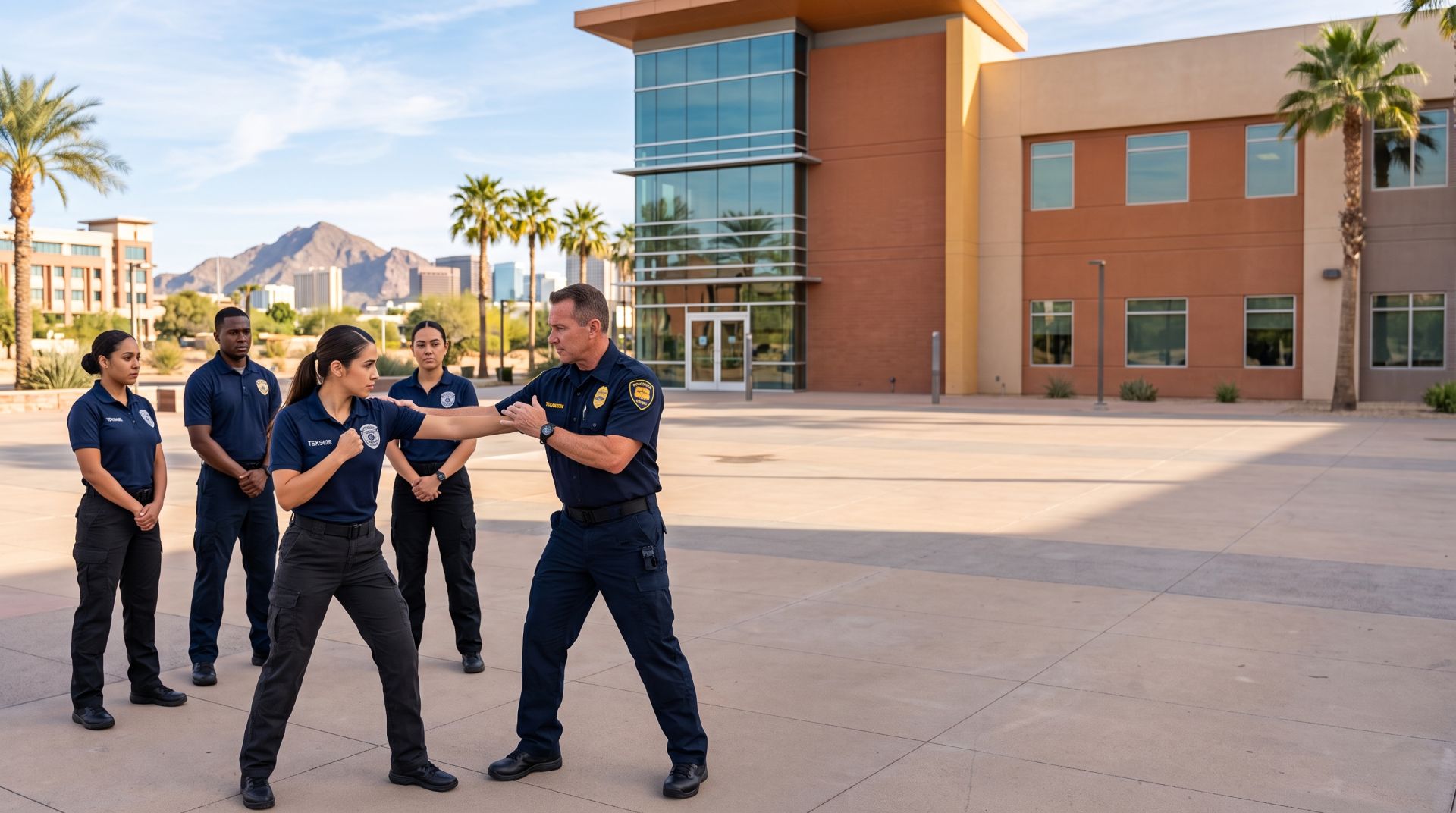
The curriculum also includes communication techniques, incident reporting, and the ethical standards expected of professionals in a position of trust. Trainees gain context for real-world situations through practical scenarios, such as responding to an unauthorized entry or managing a disturbance.
Core Components of Unarmed Security Guard Training
Training is designed to be practical and scenario-based. Unarmed security guard card training typically includes several critical modules based on the official state syllabus:
Criminal Law and Laws of Arrest
You will study specific Arizona statutes that define when a citizen can legally detain someone, the difference between criminal and civil matters, and how to act within the law during confrontations.Use of Force
This module introduces the “Force Continuum,” emphasizing verbal de-escalation techniques and appropriate physical response if intervention becomes necessary.Emergency Response
Security personnel are often the first on the scene during emergencies. You will learn to handle medical incidents, fire alarms, and other urgent situations until first responders arrive to protect both the public and the officer.Uniform and Grooming
Covers authorized uniform requirements under Arizona regulations, proper wear standards, and professional appearance expectations while on duty.Communications
Focuses on report writing, note-taking, grammar standards, and effective verbal communication, along with managing interactions in high-stress situations.Crime Scene Preservation
Covers procedures for securing and protecting a scene, controlling access, and preserving evidence integrity prior to law enforcement arrival.Ethics
Addresses professional conduct standards, both on and off duty, including behavior expectations that may impact certification and continued licensure.Sexual Harassment
Explains identification of verbal, non-verbal, and direct forms of harassment, along with prevention principles and appropriate reporting protocols.
Step-by-Step Pathway to Unarmed Guard Card Licensing
To become licensed efficiently, applicants must complete each AZDPS requirement in the correct order:
Select a certified provider
Enroll in an eight-hour unarmed guard card course through an AZDPS-approved instructor or training agency.Complete the training
Finish all modules and pass the examination to receive your Training Verification Form.Submit and pay
Complete your application through the AZDPS Public Services Portal (PSP), including your training verification, ID, and proof of legal status. Online submission is recommended for faster processing.Complete fingerprinting and photo capture
After submitting and paying, schedule fingerprinting with the state-preferred vendor (Fieldprint) using the reference code issued in your PSP inbox. Your photograph will also be taken during this appointment and submitted electronically to DPS.Practical tips for applicants
Check your criminal record for eligibility before enrolling, keep copies of all training and payment receipts, and consider digital submission to speed up processing.
Forge Your Career in Arizona
Starting a career in private security requires proper training. By understanding the AZDPS-mandated curriculum, completing the eight-hour training, and following administrative procedures, applicants transform from being civilians to trained security professionals, ready to protect property and people.
For a flexible, state-certified option, you can complete the required eight-hour unarmed guard training online through GuardCard.com and receive your mandatory training verification form needed to apply for your Arizona unarmed guard card.
Inquire today and let us help you in your budding security career.
FAQ
1. Can I work while my application is being processed?
No, Arizona law requires you to have the physical card or official digital authorization in your possession before standing a post.
2. How long does it take to get approved?
The standard processing timeframe is typically 2–3 weeks, though it may be faster or take longer depending on DPS workload.
3. Does the card expire?
Yes, your Arizona unarmed guard card is valid for four (4) years and requires an eight-hour refresher course for renewal.